Home / Emperors / Han Dynasty
Emperor Gaozu of Han
汉高祖
Liu Bang, 256 – 195 BC· founding emperor of the Han dynasty from 202 BC
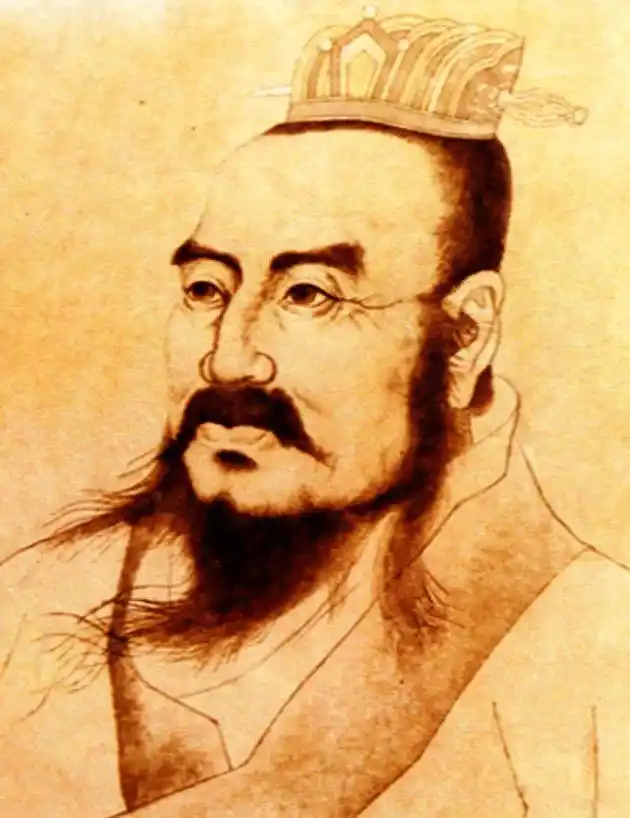
Liu Bang was in his forties when he became a rebel and past fifty when he became an emperor, and in the seven years between he fought a civil war against the finest soldier of his age and lost almost every battle. He was broken at Pengcheng so completely that his father and wife fell into enemy hands; he escaped a siege at Xingyang only because a subordinate dressed in his robes and let himself be killed in his place; he took an arrow in the chest that troubled him until it killed him. Xiang Yu won the battles. Liu Bang won the war.
He did it with a talent that has nothing to do with generalship. Explaining his success to his own court, he named three men — a strategist, an administrator, a commander — said he was inferior to each at his own work, and observed that his single gift was the ability to use them. He was also, by the standards of the emperors around him, an odd man: born in a village, employed at the bottom of the Qin bureaucracy, uneducated, fond of drink, given to insulting his ministers to their faces. The Qin had ruled through law and fear and lasted fifteen years. The Han ruled through compromise and lasted four centuries.
1. A Commoner in a Broken Empire (256 – 209 BC)
He was born in the village of Zhongyang in Feng, a district of Pei, in what is now northern Jiangsu. The Han commentator Huangfu Mi gives the year as 256 BC; Fu Zan, reckoning from a line in the History of the Han that the emperor took the throne at forty-two and died at fifty-three, gives 247 BC. Both cannot be right, and the sources nearest to him — the Records of the Grand Historian, the History of the Han, the Comprehensive Mirror — give no year at all. Chinese scholarship has generally preferred 256 BC, the year the last Zhou king died and the Qin took the nine ritual cauldrons. What is certain is that he was born a subject of Qin in country that had belonged to Chu.
His family was not noble. The Records call his father Old Man Liu and his mother Old Woman Liu, which is not a record of names but the absence of one, and it is the strongest evidence that he came from the bottom. The dominant view is that his people were hereditary minor clerks, the class that staffed the lower reaches of the Qin state; a minority holds that they were moved from the Wei capital when Qin destroyed that state and belonged to a fallen gentry. Either way he was neither a peasant in the fields nor a lord: a functionary at the edge of the map, the kind of man a great empire needs in enormous numbers and never remembers.
His post was headman of Sishui, with duties covering the post station, local order, and the escorting of convicts, and he did not take it seriously. The Records has him drinking on credit at the wineshops and never settling the bill, fond of wine and women, mocking the clerks in his own office, and wholly uninterested in the family farm. The same source says he was generous with money, open in manner, and had a way with people. A wealthy man named Lü, newly arrived in Pei, held a banquet and announced that no one giving less than a thousand coins could sit at the head table. Liu Bang arrived, gave nothing, announced ten thousand, and was seated at the top by his host, who had a reputation for reading faces and decided on the spot to marry his daughter to him. The daughter, Lü Zhi, outlived him to rule the empire herself.
Seeing the First Emperor's procession pass, he said that a real man should be like this. Xiang Yu, watching the same emperor elsewhere, is said to have remarked that the man could be replaced — two sentences that became shorthand for the difference between them. Around 209 BC, escorting prisoners to forced labour at the emperor's mausoleum, he found men escaping along the way. Rather than arrive short and be punished for it, he released them all and fled into the marshes of Mount Mang with a band of volunteers. It was the first decision of his life that was unmistakably his own, and it made him an outlaw on the eve of the collapse that would make outlaws useful.
2. The Uprising and the Road to Guanzhong (209 – 206 BC)
The collapse came fast. In 209 BC two conscript officers named Chen Sheng and Wu Guang, delayed by rain and expecting execution for lateness, mutinied. Their rising was crushed within months, but it lit a dozen others. When the magistrate of Pei tried to close the town against the rebels he was killed, and the men of Pei — among them Xiao He, Cao Shen, and Fan Kuai — sent for Liu Bang and made him their leader. He took the title Duke of Pei, chosen according to Chu custom rather than Qin law, which tells us where these men thought they belonged.
For three years he was a subordinate commander in a coalition. He attached himself to Xiang Liang, uncle of Xiang Yu, and when Xiang Liang adopted the pretender Xiong Xin as King Huai of Chu, Liu Bang accepted the arrangement as a matter of course. Xiang Liang was killed in 208 BC and the coalition fragmented. In the aftermath King Huai split his forces, sending one column north under Xiang Yu to relieve the siege of Julu and one west toward the Qin heartland, with a promise attached: whoever first entered and pacified the region inside the passes would be made king of it.
The promise mattered because the two columns were not equally difficult, and the council knew it. Xiang Yu was the most feared commander on the rebel side and also the most feared politically, having a habit of destroying cities that resisted him and executing officials who surrendered. The Records say the elders of Chu objected to sending him west on the grounds that the Qin population would fight to the last rather than submit to a man of his reputation. Liu Bang was preferred because he was a kuanda zhangzhe, a generous elder — someone who could be trusted to arrive without a massacre in mind. He was not chosen as the better soldier but as the better occupier, and he proved it by moving slowly: avoiding the strongest Qin forces, negotiating surrenders, absorbing local troops and local advice. Joined by the strategist Zhang Liang, he defeated a Qin army at Lantian in late 207 BC and advanced to Bashang, within sight of the capital at Xianyang.
The last Qin ruler, a young man named Ziying, came out with the imperial seals around his neck and surrendered. The dynasty that had unified China fifteen years earlier and intended to last ten thousand generations had ceased to exist, ended not by the great battle at Julu but by a column that had spent its time avoiding battles. Liu Bang entered Xianyang and refrained from the two things that would have ruined him. He did not take the palaces or the treasury for himself; he sealed them and set guards. And he did not impose the Qin law code on the people he had just conquered. He assembled the elders and told them the harsh statutes were abolished, that they would be governed by three rules — murder punished by death, injury and theft punished according to their kind — and that he had come to restore order rather than plunder. Sima Qian records that the people of Guanzhong were delighted and brought food and drink to his troops, and that he turned the gifts away.
3. The Banquet at Hongmen (206 BC)
The column that had done the real fighting arrived late and found the prize taken. Xiang Yu, having destroyed the Qin's main field army at Julu, marched on the passes with the other contingents behind him and found the way closed by troops who refused him entry. The guard had been Liu Bang's doing, an attempt to hold what the coalition had promised him, and Xiang Yu broke through it. By tradition he led several hundred thousand men against perhaps a hundred thousand, and the passes behind Liu Bang were already breached.
The crisis was resolved first by a personal tie and then by an act of submission. Xiang Yu's uncle Xiang Bo had once been saved by Zhang Liang and rode in the night to warn him; Liu Bang, advised that his only chance was to appear before Xiang Yu, went the next morning with a small escort. The Records preserves the scene in detail: the banquet at Hongmen, Fan Zeng raising his jade disc three times as a signal to strike, the sword dance of Xiang Zhuang meant to end in a killing stroke, Xiang Bo rising to dance as well and shielding Liu Bang with his own body, and Fan Kuai bursting in with shield and sword, eating raw meat, and telling Xiang Yu that a man who had done such service ought not to be slaughtered. Liu Bang left the table on the pretext of a visit to the privy and did not come back. Posterity has generally held that Xiang Yu's hesitation cost him the empire, which is too simple — he had wanted submission and had received it in front of the whole coalition. But the episode revealed something durable. Xiang Yu preferred the satisfaction of a rival on his knees to the removal of the rival. Liu Bang preferred to be on his knees and alive.
Xiang Yu then did what the elders of Chu had feared. He entered Xianyang, killed Ziying, looted the palaces, and burned them; the Records says the fires lasted three months. He declined to make himself emperor, taking the title Hegemon King of Western Chu, and settled the empire by carving it into eighteen kingdoms distributed among his commanders and such of the old nobility as had supported him. It was a settlement meant to restore the pre-Qin world of many states with him the strongest among them. He kept the best territory and gave Liu Bang the worst — the distant southern frontier of Ba, Shu, and Hanzhong, beyond mountains hard to cross in either direction. To keep the mountains hard he gave the region inside the passes to three generals who had surrendered to him at the fall of Qin, men whose soldiers were Qin soldiers and whose loyalty to the rebellion was thin. Their lands were known as the Three Qin. The intent was a buffer. It became a door.
4. Five Years of Losing: The Chu–Han War (206 – 202 BC)
Liu Bang went south with a defeated army, a burned road behind him, and a general who had to be persuaded twice before he would take the job. Han Xin was a young officer from a poor family who had held no important command, and whose reputation rested on conversations with Xiao He about the shape of the war. Liu Bang made him a general, and Han Xin justified it immediately by doing what no one expected: rather than force the guarded routes, he sent a detachment to repair the plank road through the mountains in full view of the Three Qin and took the main army by an unguarded pass. The phrase attached to the operation — openly repair the plank road, secretly cross at Chencang — became a proverb.
What followed was five years in which he lost. In 205 BC, with Xiang Yu engaged far to the east, Liu Bang assembled the other dissatisfied kings, marched on Xiang Yu's capital at Pengcheng, and took it. Xiang Yu turned back with a flying column and destroyed him. The Records says the Han army was driven into the Sui river in such numbers that the water stopped flowing, which is the figure the ancient histories reach for when a disaster is beyond counting. Liu Bang's father and wife were captured and spent the rest of the war as hostages.
In the confusion the sources lose track of his children, and this is one of the places where the Records contradicts itself. The biography of the First Emperor's successor says that after the defeat Liu Bang sent men to find his family and recovered only his son. A different chapter says his general Wang Ling brought both children out through the battle at the Sui river. A third version, in the biography of Xiang Yu and in the collective lives of the generals, has Liu Bang meet the children on the road and — with enemy cavalry closing — push them out of the cart three times, until the driver Xiahou Ying stopped the horse, picked them up, and put them back. The accounts cannot be reconciled, and the version most often repeated is the least flattering.
Pengcheng decided the character of the war. Liu Bang could not beat Xiang Yu in the field, and after that first attempt he largely stopped trying. He fell back to a line through Xingyang and Chenggao, anchored on the granaries at Ao and supplied from Guanzhong along the routes he had secured, and stayed there for two years, absorbing attacks. The strategy that won the war was being executed elsewhere. While Xiang Yu hammered at him in the centre, Han Xin took the eastern theatre piece by piece — Wei, Dai, Zhao, then Qi, and at the Wei river the Qi-Chu relief army under Long Ju. Peng Yue, operating in the old Liang territory behind Xiang Yu's lines, cut his supply routes. Ying Bu, King of Jiujiang, was induced to defect. Xiang Yu was winning every engagement he personally commanded and losing what he needed to keep doing it.
There was a moment when Liu Bang's own general tested him. Han Xin had conquered Qi and asked to be made king — a pretend king, he said, because the territory needed a ruler and the situation was unsettled. Liu Bang was surrounded and losing at the time, and his first response, according to the Records, was to curse the messenger. Zhang Liang and Chen Ping each stepped on his foot, and he understood. He changed the sentence in the middle of it and gave Han Xin the title outright, without the word pretend. He then had to make the same concession to Peng Yue. It is the instinct that saved him at Hongmen, applied to the people who worked for him: recognise exactly what a person's continued loyalty is worth at this moment, and pay it.
In 203 BC the two sides agreed to divide the empire along the Hong Canal, west to Han and east to Chu. Xiang Yu began marching east. Liu Bang, advised by Zhang Liang and Chen Ping that this was the moment to finish the war rather than the moment to be honourable, turned around and followed him. At Gaixia the Han armies under Liu Bang, Han Xin, and Peng Yue surrounded the Chu force, and the Records says Xiang Yu heard the songs of Chu being sung from the Han camps and concluded that Chu must already have fallen. He broke out with a small body of cavalry and reached the Wu river, where a boatman offered to take him across to Jiangdong and a chance to raise another army. He refused, saying he had no face to meet the men of Jiangdong, and killed himself.
When the fighting stopped, Liu Bang held a banquet and asked his ministers why he had won. Two of them answered that he was rude and contemptuous of people while Xiang Yu was decent to his followers, and that he had won nevertheless because he shared out the spoils while Xiang Yu begrudged honours and would not part with a fief even after the seal had worn smooth in his hand. Liu Bang said they had grasped one reason but not the main one, and named his three: Zhang Liang, whom he could not match at strategy; Xiao He, whom he could not match at keeping an army fed; Han Xin, whom he could not match in command of troops. Each better than him at his own work, and all three used by him. It is not modesty but an accurate description of a specific skill, and the phrase he used for it — jiang jiang, to lead the leaders — was one Han Xin had used about him first.
5. The Emperor, the Capital, and the Kingmaking (202 – 195 BC)
In early 202 BC, at Dingtao, Liu Bang was proclaimed emperor. The title was a Qin invention that had died with the Qin, and there was no expectation it would be revived; the settlement Xiang Yu built had assumed a world of kings with one of them first. Liu Bang took the imperial title anyway, and with it the Qin machinery: the emperor at the apex, a chancellor and a commander-in-chief and a censor-in-chief beneath him, and an empire administered through commanderies and counties whose officials were appointed from the centre and could be removed by it. His advisers debated reviving the ancient practice of enfeoffing princes and decided against it.
He began, however, by placing his capital badly. The natural choice was Luoyang, in the old central plain, and it was where he first installed himself. A commoner named Lou Jing, a soldier assigned to guard the frontier who had requested an audience instead, argued that the geography pointed west: Guanzhong, he said, was protected by mountains and rivers on four sides and could be held by a single man against attack from any direction. Zhang Liang agreed, adding that the region was fertile and distant from the eastern plains where the fighting had happened. Liu Bang moved the capital to Chang'an that same year. Lou Jing was given the surname Liu — a member of the imperial clan by decree — which was how the Han absorbed informants and servants into the family.
The most famous demonstration of how the new order intended to work came at court. Liu Bang's followers were soldiers and clerks who had spent their lives in camps and county offices and treated the imperial household as an extension of a war council: at banquets they shouted, argued, drew weapons, and cut up the furniture. The scholar Shusun Tong, who had served the Qin and made a career of knowing when to serve whom, was asked to design a proper ceremony, and did it with two months of rehearsal. At the next assembly the officials entered in order, stood in ranks by rank, and performed their obeisances while the emperor sat above them. The Records says Liu Bang observed that he now understood what it meant to be emperor — usually read as comedy about a man acquiring a taste for grandeur, but better read as an observation about a practical problem: an empire assembled out of a coalition of warlords could not be run as one, and ritual was the cheapest available technology for turning followers into officials.
The most consequential problem was that he had already promised away pieces of his own empire. To keep the men who were winning the war on his side he had made his commanders kings: Han Xin over Qi and then Chu, Peng Yue over Liang, Ying Bu over Huainan, Zhang Er over Zhao, Zang Tu over Yan, a second Han Xin over territories also called Han, and Wu Rui over Changsha. These were not nominated governors but sovereigns with their own armies, revenues, and administrations, created precisely because they were too strong to command. Between 202 and 195 BC he eliminated the problem, and the method was rarely honourable. Han Xin was moved out of Qi, the base where his authority rested, arrested on the pretext of a plot, demoted, and then executed by the empress Lü Zhi — an act Liu Bang accepted and, on some accounts, regretted. Peng Yue was arrested, spared exile, and killed on the empress's orders. Ying Bu revolted rather than wait and was killed in the field in 195 BC, having wounded Liu Bang with the arrow that would eventually kill him.
Having removed the men who might take the empire, Liu Bang replaced them with men who posed a different problem: he made his own relatives kings, nine of them across the east, on the theory that brothers and sons would defend the family interest. In his last year he had a white horse killed and bound his ministers to an oath that only members of the Liu clan could be made kings, and that anyone who violated this would be attacked by all the rest. The White Horse Oath is reported in two slightly different forms in the Records, and some historians doubt it happened as described. Whether the ceremony took place or not, the principle governed Han politics for two centuries, and its first test came at once: after Liu Bang's death the empress dominated the court for fifteen years but could not make her own relatives kings while Liu loyalists lived, and when she died her clan was destroyed.
The arrangement had created its own successor problem. The kingdoms kept real powers — their own officials, taxes, and armies — so that the concession which bought loyalty during the war left the empire with two systems in its eastern half and one in the west. The result was a slow contest between the court and its own relatives. It was the emperor Jing who tried to cut the kingdoms down in 154 BC; the kings resisted; the revolt known as the War of the Seven Kingdoms nearly succeeded before it was put down. It was the emperor Wu who solved it, not by war but by requiring each kingdom to be divided among all a king's sons, so that every generation broke the realm into smaller pieces. The founders of the Han had made a compromise with feudal power to win a war. Their descendants spent a century undoing it.
6. Governing a Ruined Land (202 – 195 BC)
The empire Liu Bang took in 202 BC was not merely poor. It had been fought over for eight years by armies living off the land, and the History of the Han records the results in terms that read like a description of famine: grain worth ten thousand coins a measure, a horse a hundred pieces of gold, and the emperor himself unable to find four horses of the same colour to pull his carriage, so that the highest officials of the state rode oxcarts. The Qin had pushed taxation and conscription to the limit and lost everything; most of the men now responsible for running the state had been on the receiving end of Qin administration before they were on the giving end of their own.
Their measures were coherent and unglamorous. Soldiers were demobilised and sent home, and those who had come from the east and chose to stay in Guanzhong were exempted from labour service for twelve years, those who went back for six. Officials and soldiers below a certain rank were promoted, given land and houses, and exempted from taxes and labour for themselves and their households, converting the obligation to serve into a stake in the countryside. Where the old aristocratic titles of the pre-Qin world had survived among families living in hiding, those titles and their land were restored, which quietly bought the loyalty of the provincial elite. Anyone who had sold himself or a child into slavery during the famine was made a free commoner again, and the rich were required to pay for the privilege — a measure as much about fiscal policy as about mercy, since slaves paid no tax and free farmers did.
The tax rate was cut to one part in fifteen of the harvest, which makes no sense as a revenue measure and perfect sense as a recovery measure. Merchants were treated with contempt — forbidden silk clothing, weapons, riding horses, and office, and charged a doubled poll tax — because a government with a currency it could not yet control and a countryside it needed to repopulate wanted men in the fields rather than moving goods. The legal code was rebuilt along Qin lines and softened: Xiao He took the Qin statutes, pruned them, added provisions on households, conscription, and stables, and produced the nine-chapter Code, replacing the improvised three-point promise of the first year with something an empire could administer.
The intellectual frame came from a man Liu Bang had initially refused to meet. Lu Jia arrived at court talking about the Book of Songs, and the emperor told him bluntly that he had taken the empire on horseback and had no use for poetry. Lu Jia is said to have answered that it could be taken on horseback but could not be governed from one, and that the Qin's single-minded reliance on severity was precisely why it had lost. Liu Bang, who had just watched a dynasty organise its own destruction that way, told him to write it down; the result was a book of twelve essays arguing that a ruler should do less, tax lightly, and leave the population alone. The philosophy that governed the first sixty years of the Han was generally called the learning of the Yellow Emperor and Laozi — non-interference, whose real content was fiscal restraint, low labour demands, and an absence of grand projects. Its appeal is shown by how it survived its author. Xiao He was succeeded as chancellor by Cao Shen, who had served with him in Pei and made a point of changing nothing at all; when the emperor's son complained, Cao Shen asked whether the young man thought himself a better administrator than his father had been, and when he admitted he was not, observed that there was therefore no reason not to follow the existing arrangements exactly.
The contrast with the previous dynasty was the whole point. The Qin had built roads, walls, canals, and palaces, and measured its strength in the scale of what it could compel; its own legal code, found in a tomb in Hubei in 1975, shows a state whose population existed to serve the army and the throne. The Han did the opposite arithmetic. It reduced its demands, released the people it held, and accepted a smaller state in exchange for one that might survive. Everything later called the greatness of the Han — the campaigns into Central Asia, the Silk Road, the expansion under Wu — rested on two generations of deliberately doing nothing very much.
##
- The Frontier, the Last Years, and the Verdict of History (200 – 195 BC)
The one place where restraint failed was the north. The Qin had cleared the Xiongnu from the Ordos and built walls; after the Qin's collapse and eight years of civil war the steppe confederation had reorganised under a chanyu named Modu, who had unified the northern tribes and was building an empire of his own. A northern king named Han Xin — a different man from Liu Bang's general — defected to the Xiongnu, and Liu Bang marched north. He moved against advice, advanced ahead of his main body with a small force after accepting the enemy's deception of weakness, and found himself cut off at Pingsheng on the slopes of Bai Deng, surrounded for seven days. He escaped, according to the Records, by paying a large sum to Modu's consort, who persuaded her husband that a captured Chinese emperor would be less useful to him than a live one willing to negotiate.
The consequence was the abandonment of any attempt to settle the northern frontier by force. From 198 BC, Han policy toward the Xiongnu was marriage alliance and the formal exchange of goods: a woman of the palace presented as an imperial daughter, sent to the steppe each time an agreement was renewed, accompanied by fixed quantities of silk, grain, and wine, and matched by the opening of border markets. Chinese writers were uneasy about it from the beginning, and later generations attacked it as a humiliation. It was in fact clear-eyed arithmetic. The Qin had spent enormous resources fighting the steppe and had not won; the tribute was cheaper than the war, and the policy held, imperfectly, for sixty years.
In 196 BC Ying Bu revolted and Liu Bang took the field himself. He was in his late fifties by the more conservative reckoning of his birth and in his sixties by the traditional one, and the campaign wore him out; he was hit by a stray arrow, won the battle, and was carried back ill. On the way home he stopped at Pei, the district where he had been born and had worked as headman, and held a banquet for the men and women he had grown up with. He called a hundred and twenty children from the town and taught them a song he had written in the dialect of Chu: A great wind rises, the clouds fly and scatter. Across the four seas the power is mine, and I have come home. Where do I find brave men to guard the four borders? The Records says he sang it himself, with the children in chorus, and then wept, telling the men of Pei that a man who has gone out into the world and won it still longs for home. It is the only poem of his that survives, and it is remembered for its last line, which is not about triumph but about the shortage of reliable men.
The succession nearly broke the dynasty before it had properly begun. His empress, Lü Zhi, had borne him the crown prince, Liu Ying; his favourite, Lady Qi, had borne him a son named Liu Ruyi, whom he thought more like himself and several times tried to put in the crown prince's place. The court resisted, and the argument that settled it was theatrical. Four aged scholars known as the Whiteheads of Mount Shang — men Liu Bang had invited to serve him for years and who had always refused — appeared one day behind the crown prince in his train. Seeing them, the emperor concluded that his son had won the allegiance of men whose respect he himself had never managed to earn, and told Lady Qi that the boy could no longer be moved. What he left behind was a woman he had made empress and a woman he had preferred, and no arrangement that could protect the weaker of them. The empress had Lady Qi mutilated and the boy killed, and the dynasty's own historians recorded it without excuse.
He died the following year, still unable to displace the son he had settled for and unable to protect the son he had preferred. The verdicts on him diverged almost immediately and have not converged. Sima Qian, writing a century later, called him the da sheng — a great sage — and asked how a man with no territory to his name could have made himself emperor. Ban Gu, writing the dynasty's own history, described a ruler with no literary accomplishment at all whose virtue was that he was open, could think, and would listen to anyone from a gatekeeper to a conscript. Han Xin, who had reason to hate him, said he could not command troops but could command the men who did. Wei Bao, who deserted him, said he was rude and humiliated his own ministers. The two assessments are both in the record and both accurate.
The unfavourable version began later and grew. Ruan Ji, a third-century poet, looked over the old battlefield and complained that in an age without heroes even a small man could make a name. A Yuan dynasty dramatist, Sui Jingchen, wrote a satirical ballad about the emperor returning to his home village and filled it with petty thefts, unpaid debts, and fraud — though scholars now read the piece as an attack on the Mongol court's own habit of returning north each year. By the twentieth century Liu Bang had become the archetype of the vulgar emperor, the illiterate peasant who lied and cheated his way to power and then murdered his friends, and this is the version most people meet. It is not the version Sima Qian wrote.
What survived him is not his personality, which remains genuinely unattractive in the ancient sources, but the arrangements he accepted as necessary and did not have the strength to refuse. The Qin had tried to govern through uniform law and the destruction of everything that stood between the throne and the person, and had lasted fifteen years. The Han kept the Qin bureaucracy and, for two centuries, gave away half the empire to buy time. The names by which the Chinese majority still describes itself, the script, the language, and the sense of a continuous civilisation, are all derived from the dynasty he founded. The man who did that was a village official who spent the first half of his life in obscurity and the second half winning battles he should have lost, and his own summary of his achievement — that he had found better men than himself and used them — remains the best single sentence anyone has written about why he was there.